Iso Container Corner Castings For Boats
- Aluminum Corner Caps, ISO Corner Fittings, Rub Rails & Plugs from Chassis King. We carry a wide selection of chassis, trailer, and container parts to suit your needs.
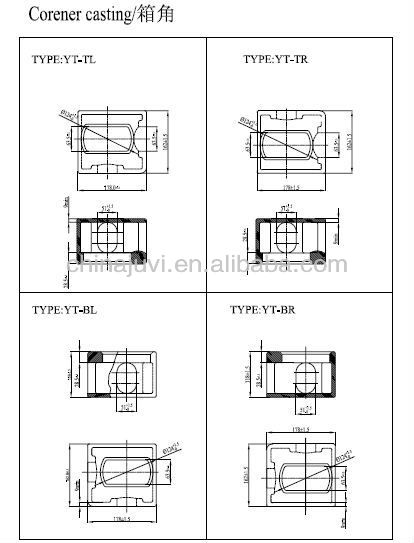
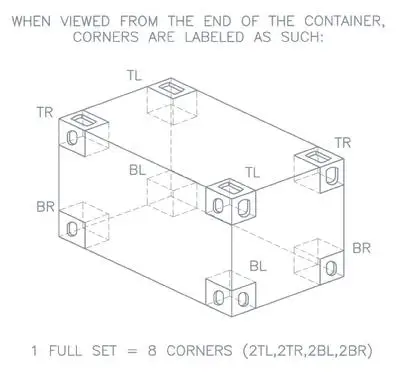
- ISO 1161 Steel Container Corner Castings: Sold in sets of 8 container corner castings (or individually) 200 lbs weight per set / 25 lbs. Meets the ISO Standard (ISO 1161) for Container Corner Castings. There are 2 each of 4 different marine shipping container corner castings per set: Bottom Left, Bottom Right and Top Left and Top Right.
- Model Container Ship Above deck Below deck Total Storage 1 Storage Using VTLs Total Liftlocks 2 Loading/Unloading VTL Profile 3 1000 333 4000 333 (2 at a time) 637 (1 at a time) 2000 0 0 2000 (1 at a time) Source: Office of Regulatory Analysis. 1 VTLs can only be used above deck.
2 Since liftlocks can only be used for VTLs, the Agency assumes that all locks used to store containers will be certified liftlocks. 3 The costing will be based on a full unloading of the ship. Benefits This section reviews the populations at risk of occupational injury or death during the vertical tandem lifting of containers. OSHA anticipates that the proposed standard will decrease the time associated with moving containers from vessel to dock and vice versa and may decrease risk by reducing the total number of lifts per job. To assess the benefits of the proposed standard, OSHA has conducted an historical analysis of the frequency of VTLs and the time associated with such lifts, using a model container ship. These data were used to calculate the reduced time needed to complete a job using VTLs as opposed to lifting one container at a time. The following section estimates the increase in productivity OSHA expects affected employers to realize and describes the methodology used to develop these estimates.
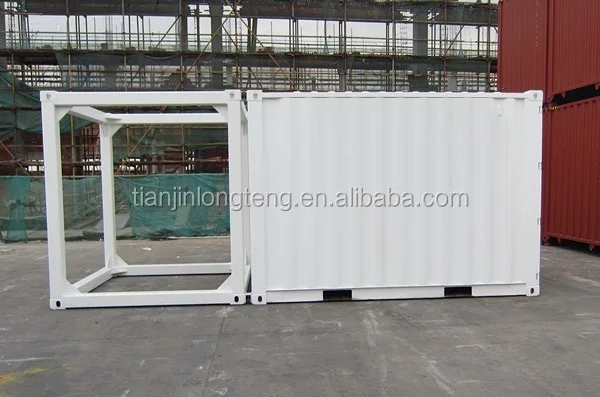
This is a model of the corner connections used on ISO standard shipping containers. Use this as a start part when designing a rack or skid that can be handled or shipped like a container. It has configurations for the standard 1A thru 1F sizes.
Cost Savings Due to Productivity Gains This analysis begins with the model container ship, as described above in Table 3. The cycle time estimates used to calculate cost savings are two minutes per container for single lifts (30 containers per hour) and 2.6 minutes for two containers (a total of 45 containers per hour) using VTLs.
The actual amounts of time could vary considerably from port to port and across crane operators. These productivity gains are based on moving only two containers in a VTL. The Agency is assuming that the cycle time for loading or unloading a ship with containers is approximately the same. For the loading of the ship, the cycle time includes applying liftlocks to the bottom corner castings so that when they are put on the ship, they automatically lock into place.
For the unloading of the ship, this time includes removing the liftlock from the containers. The actual time is dependent on the skill of the crane operator and the cargo plan.
An experienced crane operator can move about 30 forty-foot containers per hour, one at a time, depending on the crane, characteristics of the ship, terminal, wind, etc. The Agency is assuming that by using a VTL, the same experienced crane operator can move about 45 forty-foot containers per hour.
Using the model container ship, there are about 333 containers stored above deck that could be moved using a VTL. The productivity gains are represented by the difference between moving the containers one at a time and two at a time. BILLING CODE 4510-26-P There are several factors that will influence the cost estimate of moving containers one at a time versus using VTLs.
Based on the model container ship, there are 333 containers stored above deck that can be moved via VTLs. Therefore, dividing the 333 containers by the total number of containers that the crane operator can move in an hour (30), it will take the crane operator about 11.1 hours for these containers.
On the other hand, if the crane operator were moving the containers by VTLs, it would take about 7.4 hours, a 3.7 hour difference. This is the decrease in labor time needed for the unloading by VTLs instead of one at a time. Other gains in productivity will be the decreased land and crane rental time needed by the stevedoring companies, which is a direct result of the 3.7 hour decrease in time using VTLs. There may also be a cost saving from shorter dock or pier rental time for the ship. As mentioned earlier, stevedoring companies rent the land and the cranes from the port authorities to load and unload ships.
OSHA assumes that the crane costs $500 per hour with a 4-hour minimum rental. In this case, as shown in Table 4, 3.7 hours less of crane rental results in cost savings of $1,850 per ship unloaded using VTLs. In addition to the crane rental savings, changes in labor costs must also be considered. Without using VTLs, the container handling involves a labor cost of $7,875 (15 persons times 11.1 hours times the wage rate of $47.30). VTL unloading requires an estimated three additional crew members beyond that required for normal unloading, but for a shorter period of time. Since performing the VTL unloading will take 7.4 hours (based on the container ship model), the cost of unloading using VTLs will be $6,300 (the cost of 18 employees times $47.30 per hour times 7.4 hours).
Comparing the two, the savings in labor costs is $1,575 per ship unloaded using VTLs ($7,875 minus $6,300). There may be substantial productivity gains to be realized by other parties. The shipping line gains a 3.7 hour reduction in time to deliver cargo, which translates to a higher return to capital for the ship owners. In addition, the shipper receives the goods 3.7 hours sooner, which could reduce inventory and other costs. The Agency did not estimate savings in port charges paid to unload the ship or in inventory costs to shippers.
However, the Agency believes these efficiency cost savings may be significant and seeks comment. The table below on productivity gains assumes that the containers are pre-stacked VTLs prior to the ships docking to ensure that the productivity gain stems solely from the act of moving the containers and not from any other source. Based on the table of productivity gains, moving two containers at one time would yield the highest marginal productivity gain. Based on the model and assumptions of cycle times, higher total productivity gains may be possible with VTLs of more than two containers. When moving more than two containers simultaneously, the gain diminishes for each added container. This diminishing gain stems solely from the assumptions in the model of the number of containers per hour and the minutes per lift variables. This analysis is dependent on the estimate of the number of containers per hour that can be moved.
Iso Corner Casting
The 'decreased lifts per hour' column captures a possible measure of where some effect on risk may occur. Fewer lifts may result in less risk.
The Agency has preliminarily concluded that, when the proper work practice precautions as specified in the proposed standard are followed, the relative safety risk of two- container VTLs and single lifts are approximately the same. The Agency does not have any data to quantify this portion of risk. The Agency seeks comment on this approach. Productivity Gains Number of containers per lift Containers per hour Lifts per hour Minutes per lift Decreased lifts per hour Marginal gain from lifts (minutes) 1 2 3 4 5 30 45 55 65 75 30 22.5 18.3 16.25 15 2 2.7 3.3 3.7 4.0. 7.5 4.2 2.1 1.3.
0.7 0.6 0.4 0.3 Source: Office of Regulatory Analysis. Based on the model container ship profile, the Agency preliminarily estimates the benefits of using VTLs are $3,425 in direct cost savings for stevedoring costs for each VTL related operation. If, as estimated in the next section, VTLs are used for 156 jobs per year, then the total annual cost savings in stevedoring costs would be $534,300 per year. In addition, the shipper receives the cost saving associated with 3.7 hours less time needed to load or unload containers.
Dance house vol 1 nexus download fl. Nexus2 Expansion Dance Vol.1. By hoangbao Published May 6, 2017 Updated October 1, 2017. Nexus2 Expansion Dance Vol.1®. BAPitchbass 1 BAPitchbass 2 BAPitchbass 3 BAPitchbass 4 BAPitchbass 5 BAPitchbass 6 BAPrd Sidechain Bass BAScreambass BASpeedope BLBig Balls Eh Bells.
This 3.7 hours translates into faster shipping service to shipper and improved productivity for shipping capital. The benefits also include decreased dock, or marine terminal, rental time and port fees associated with loading or unloading the ship. Due to the lack of data, the Agency has not quantified these benefits. The estimates are based on a 'per job' basis; that is for a single loading or unloading operation of a container ship. Costs of Compliance This section presents OSHA's analysis of the estimated costs of compliance to be incurred by affected employers. This cost analysis is primarily based on the profile of affected workers and industries presented in the Industrial Profile section of this Preliminary Economic Analysis. The first section outlines the provisions of the proposed standard that are expected to impose costs on employers and describes the nature of those costs.
The next part presents OSHA's assumptions and preliminary assessments with regard to current compliance, unit costs, life of equipment and programs, baseline data, and other data required to make compliance cost estimates. This section also describes OSHA's model container ship profile. Following the discussion of analytical assumptions and baseline data, this section examines, requirement by requirement, the expected costs of compliance by the model container ship and for the Marine Cargo Handling and Longshoring industries. Performing VTLs is not mandatory. Employers could avoid using VTLs altogether by simply continuing to lift containers one at a time. Thus, a case can be made that this is a no cost rule with only net productivity gains. The proposal requires liftlocks to be inspected before using them for lifting and annual examinations thereafter.
These requirements reflect ILO's loose gear requirements. Many of these costs of the proposal's initial inspection and annual examinations of liftlocks would be absorbed by vessel owners rather than the stevedores (who are the employers of longshoremen). Provisions in the Proposal With Major Cost Impacts The most important provisions of the proposal are reviewed in the following paragraphs. Although many new provisions are being proposed, only five may create costs on the regulated community. A proposed provision in § 1917.46(a)(1)(viii)(A) requires container gantry cranes that handle VTLs to be fitted with a LID. This would allow the crane operator to know precisely the weight of the load. Proposed § 1917.71(b)(9) requires the employer to notify the crane operator through a cargo stowage plan of the location and characteristics of all VTL units being handled.
This is important so that the crane operator is aware of what he/she will be lifting and when. Proposed § 1917.71(j) requires employers to develop and implement a plan for transporting VTLs in a terminal. This plan must include safe operating speeds; safe turning speeds; and any conditions unique to the terminal that could affect VTL operations. Proposed § 1917.71(k) requires that the employer have a means of keeping damaged or defective liftlocks separate from operating liftlocks. This is currently being done for SATLs for lifts of single containers. Therefore, the Agency did not estimate additional compliance costs for this requirement. The proposed § 1917.71(l) requires employers to ensure that liftlocks used to make up VTLs at a terminal are the same type of certified liftlocks that are on the vessel onto which VTLs will be loaded.
This requirement will impose compliance costs not on the stevedore but on the ship owner. This cost is attributed to proposed § 1918.85(f)(3)(i) & (ii), which requires the ship owner to get the SATLs inspected prior to initial use as a liftlock for VTLs, and annually examined thereafter, based on ILO 152 convention requirements for loose gear. The requirements of initial testing, marking, and numbering the liftlocks with the safe working load (SWL) are tasks that will usually be done by the manufacturer, but for existing SATLs may be done by another company or the vessel owner. The logistics of testing, inspecting, and certifying liftlocks is difficult (for the employer/ stevedore) since the ship owner has control of the locks and most of the locks are in nearly continuous use. The Agency seeks comment on this issue.
The overall breakdown of costs by sector are as follows. Provisions With Potential Cost Implications by Sector 1917 Marine terminals 1918 Longshoring § 1917.46(a)(1)(viii)(A) - Load Indicating Devices. § 1917.71(b)(9) - Notify crane operator of cargo plan for VTLs. § 1917.71(j) - Plan for transporting VTLs in the terminal.
§ 1917.71(k) - Means for keeping damaged or defective liftlocks from operating liftlocks. § 1917.71(l)(a)(vii) and (viii) - Liftlocks must be identical.
§ 1918.85(f)(3)(i) - Initial Testing of SATLs. § 1918.85(f)(3)(ii) - Annual inspection of liftlocks by a competent person. Source: Office of Regulatory Analysis. Not all of the requirements in Table 4c will incur compliance costs on employers.
Specifically, the requirement for keeping damaged liftlocks separated from operating liftlocks is currently being done for all single lifts, thus no compliance costs are being estimated. The employer (shipper) could either replace his/her existing locks with new already certified liftlocks or have existing SATLs certified to be liftlocks. If the employer chooses to have existing SATLs certified, the Agency estimated that this activity will cost the employer $1 per lock to perform the initial testing of the lock. The SATLs would be sent to an independent testing company for these tests to be done. The testing company would also develop the certification record for the employer. The annual inspection of the liftlocks would also be done by an independent testing company at the same rate of $1 per lock. A higher cost alternative is that the owner of the ship would simply buy new liftlocks.
This would impose an enormous initial cost burden on the ship owner. Since these locks will come directly from the manufacturer, already tested, marked, inspected, and certified for lifting, the unit cost is $30 per lock. Thus, in considering the model container ship that is using 4,000 SATLs, the cost per ship would be $120,000. This cost would only be realized if the ship owner feels that it would be easier to purchase new liftlocks to enable the cargo handlers to comply with the proposal.
Also, even with the model, if the ship owner is going to prepare containers for handling as VTLs, all SATLs on board need to be certified liftlocks, and they must be of a uniform type throughout the ship. The Agency believes that this is already industry practice based on the Agency's knowledge of the industry and information in the public meetings on VTLs. Estimated Cost Using the Model Container Ship For simplicity, the Agency is assuming that two container gantry cranes will load the empty model container ship with all 3,000 40-foot containers (the ship's full carrying capacity). Based on the specifications in Table 1, the containers being loaded will be a mix of 20 and 40-foot containers. (For purposes of space on container ships, two 20-foot containers, can be stored in the space of one forty-foot container.) However, for the purposes of this analysis, only the 40- foot containers will be used in VTLs.
Forty-foot containers are more common and the analysis would not be essentially different with twenty- foot containers. Of the 3,000 40-foot containers, only 333 containers will be lifted in a VTL. Since about half of the overhead container gantry cranes currently in operation already have LIDS, there will be little difference in the average rental cost for stevedoring companies renting the cranes. The cost of retrofitting a crane with a LID is estimated to be $10,000. When this cost is discounted over 10 years at a 7 percent discount rate, the annualized cost of the LID is $1,424.
In a worst-case scenario, this total annualized cost would be passed along in full to the stevedoring company whose longshoremen are performing the VTLs. So for the purposes of this analysis, the Agency is assuming that the cranes being used for VTLs already have a LID; thus, the Agency did not estimate any additional compliance costs for this requirement. Also, the stevedoring supervisor must inform the crane operator of the vessel cargo stowage plan, which shows the location and characteristics of all VTL units to be handled (proposed in § 1917.71(b)(9)). The Agency estimates that it will take ten minutes (0.1667 hours) to perform this task. Thus, multiplying the hourly wage rate ($60.92) by this fraction of one hour, the cost is $10. According to the proposed standard, employers are required to develop a plan for transporting vertically connected containers in a terminal (§ 1917.71(j)). The Agency assumes that this plan would be developed by the stevedoring supervisor along with information from the port authority (the owner of the land) prior to the ship's arrival in port.
OSHA estimates that it will take four hours of supervisory time to develop this plan. The cost of this task is estimated by multiplying the supervisor's average wage rate of $60.92 per hour (PMA, 2003) by the four hours to complete this task. This totals $244 per establishment. In addition to the time to develop the plan, the Agency estimates that it will take employers one hour each to maintain and update the plan as necessary. The second and recurring cost year for this requirement is $61 annually per plan. The employer would also need to ensure that the liftlocks used to make up VTLs at a terminal are the same type of certified liftlocks that are on the vessel. The ship owner and stevedore must ensure that the liftlocks are certified.
The ship owner owns the liftlocks. The Agency estimates that the 4,000 SATLs needing to be certified on the model container ship will cost about $1 per lock for testing, certification, and annual examination. Thus, the cost to comply with this requirement for the model container ship is $4,000.
The Agency assumes that each affected shipper will have at least one ship that will do VTLs and need to have all of its SATLs certified. The Agency seeks comment on this assumption. Table 5 presents the estimates for the total cost of performing VTLs using the model container ship operation. Performing VTLs actually results in a net cost saving; the savings are calculated in the Benefits section of this Preliminary Economic Analysis. OSHA does not believe that the entire industry will use VTLs. At most ports, unions and stevedores must negotiate work practices, which may include the decision to perform VTLs.
The potential for VTLs is also highly dependent on the pattern of trade in each port or the cargo of each ship. The majority of the costs would not be imposed directly on the stevedore (employer), because the ship owners would need to ensure that SATLs are certified before being used as liftlocks.
Model Container Ship Operation Cost and Total Industry Compliance Costs Model containership operation cost Estimate industry compliance cost 1 § 1917.46(a)(1)(viii)(A) - Load Indicating Devices § 1917.71(b)(9) Notifying the crane operator of the VTL § 1917.71(j) Plan for transporting VTLs in the terminal § 1917.71(k) Means of Separating Damaged and Working Liftlocks 2 § 1918.85(f)(3)(i)&(ii) Testing and Examining Liftlocks Total Costs 0 10 244 0 4,000 0 1,584 1,949 0 232,000 4,254 235,533 Source: Office of Regulatory Analysis. 1These estimates were calculated mostly by multiplying the model container ship operation cost by 156 (estimate of the number of VTL jobs). 2This practice is already being done whether VTLs are being done or not, as discussed in the text. The costs of compliance in Table 6 illustrate total annualized compliance costs, estimated on a per establishment basis for each affected NAICS code. Table 6 assumes that each establishment would have at least one ship that would need to replace all of its SATLs to have them certified for the purposes of VTLs.
OSHA recognizes that this assumption may overstate the costs. Based on this data and the discussion above in the Industry Profile section, the Agency is estimating that 58 vessels would have their ship's SATLs certified for VTLs.
Estimated Economic Impacts for Affected Sectors NAICS Description Compliance cost per establishment Compliance cost as a percentage percentage of revenues Compliance cost as a of pre-tax profits 411 483113 Port and Harbor Operations Deep Sea Freight Transportation Coastal & Great Lakes Freight Transportation $233 4,000 4,000 0.00 0.00 0.01 0.01 0.04 0.14 Source: Office of Regulatory Analysis. The economic impacts outlined in Table 7 of this analysis are based on using the lowest estimate of revenues and costs from either the 100 to 499 size class or the 500 size class (see Table 2). The costs of the proposal are extremely small, and the proposed standard is economically feasible.
Regulatory Flexibility Analysis According to the Small Business Administration (SBA), a small business in NAICS 483111 or 483113 is any firm with less than 500 employees (see references below). However, for NAICS 488310, SBA defines a small business by total sales of less than $21.5 million. Using the average sales per establishment, OSHA found that the firms with less than 250 employees earned less than $21.5 million in sales annually, while establishments with more than 250 employees exceeded that sales figure.
For reasons discussed in the Industry Profile, establishments with less than 20 employees are unlikely to perform VTLs because of the size and kind of ships they service. Table 8 shows even under a worst-case scenario, the proposed requirements would have minimal impacts on small firms. Accordingly, OSHA certifies that this standard will not have significant impact on a substantial number of small entities.
About product and suppliers: Alibaba.com offers 3,986 container corner casting products. About 58% of these are cast & forged, 17% are container, and 1% are container accessories. A wide variety of container corner casting options are available to you, such as steel, iron, and aluminum.
You can also choose from free samples, paid samples. There are 3,988 container corner casting suppliers, mainly located in Asia. The top supplying countries are China (Mainland), India, and Vietnam, which supply 99%, 1%, and 1% of container corner casting respectively. Container corner casting products are most popular in Western Europe, Domestic Market, and Central America.
You can ensure product safety by selecting from certified suppliers, including 3,986 with Other, 3,314 with ISO9001, and 113 with ISO/TS16949 certification.
Comments are closed.